
Views: 0 Author: Site Editor Publish Time: 2026-11-03 Origin: Site
A food processor excels at chopping, slicing, shredding, and kneading solid or semi-solid foods using interchangeable blades and discs, while a blender is built for liquefying ingredients into smoothies, soups, and sauces using a fixed spinning blade in a tall jar. Choose a food processor for meal prep tasks like dicing vegetables; choose a blender for drinks and purees.
Walking into a kitchen appliance aisle—or scrolling through an online catalog—can leave buyers staring at a dozen machines that all look vaguely similar. Food processors, blenders, and multifunction kitchen appliances often get lumped together, yet each one is engineered for a distinct job. For wholesale buyers, distributors, and retailers sourcing kitchen appliances, understanding these differences isn't just helpful—it directly affects which products move off shelves and which ones sit unsold.
This guide breaks down the practical differences between food processors and blenders, explains where multifunction kitchen appliances fit into the picture, and offers a side-by-side comparison to help you match the right product to the right customer. Whether you're stocking inventory for a retail partner or helping a home cook decide what belongs on their countertop, this breakdown will clarify the decision.
A food processor is a multifunctional kitchen workhorse designed around interchangeable blades and discs rather than a single fixed blade. Instead of liquefying ingredients, it chops, slices, shreds, grates, purees, and sometimes kneads dough—all within a wide, short bowl that's built to handle solid and semi-solid foods.
Food processors typically come with a feeding chute for adding ingredients while the machine runs, along with a pulse function for controlled, short bursts of power. This makes them ideal for prep work that requires precision rather than speed: dicing onions for a stir-fry, shredding cabbage for coleslaw, or grinding nuts into a coarse meal.
Looking at a representative 10-in-1 food processor from JM HomeMaster illustrates the category well. The unit combines blending (1800ml capacity), grinding, and filtering functions, paired with a 1000ml bowl, stainless steel blades, and a rotary switch offering two speeds plus pulse. Available in 100-240V AC configurations, it's built for versatility across different markets and voltage standards—a detail that matters significantly for international distributors.
Home cooks who meal prep in bulk, bakers who need consistent dough kneading, and anyone who regularly handles vegetables in volume tend to gravitate toward food processors. The appeal lies in time savings: a task that takes ten minutes with a knife can take under a minute with the right disc attachment.
A blender is purpose-built for liquids and semi-liquids. Its tall, narrow jar and fixed bottom-mounted blade create a vortex that pulls ingredients down into the blade repeatedly, producing smooth, consistent textures. This design makes blenders the clear choice for smoothies, milkshakes, soups, sauces, and any recipe that calls for a pourable consistency.
Commercial and heavy-duty blenders push this further. Take the JM HomeMaster YT-211, a 400W blender with grinder functionality: it offers three speeds plus pulse, a 1.5L plastic jar (with a clear glass option), and an operating range of 110V/220V at 50/60Hz. It's also certified across CE, CB, CSA, EMC, EMF, ETL, GS, LFGB, RoHS, SASO, UL, and UR standards—a strong indicator that it's built for export across multiple regulatory markets, not just domestic sale.
For buyers sourcing commercial-grade kitchen appliances, this kind of certification breadth matters as much as wattage. A blender that clears UL and CE simultaneously can be stocked for both North American and European retail partners without separate sourcing.
Cafes, juice bars, and households focused on smoothies or soups are the core blender audience. Within the blender category itself, there's further specialization: table blenders for countertop use, portable blenders for on-the-go drinks, and commercial blenders engineered for continuous daily use in food service settings.
Feature | Food Processor | Blender |
|---|---|---|
Primary function | Chopping, slicing, shredding, kneading | Liquefying, pureeing, blending |
Container shape | Wide, short bowl | Tall, narrow jar |
Blade design | Interchangeable blades/discs | Fixed bottom blade |
Best for | Vegetables, dough, nuts, cheese | Smoothies, soups, sauces, drinks |
Typical capacity | 1,000–1,800ml bowl | 1.2–1.8L jar |
Speed settings | 2 speeds + pulse (common) | 2–3 speeds + pulse (common) |
Feeding chute | Yes, for continuous processing | Rarely included |
Texture output | Chunky to fine, controllable | Smooth and consistent |
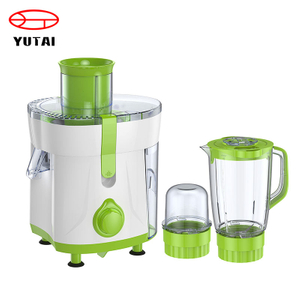
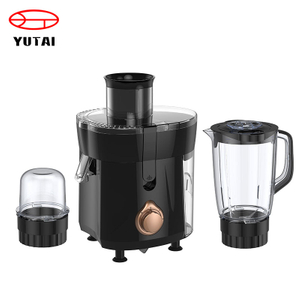
Many manufacturers now blur the line between these two categories deliberately. Multifunction kitchen appliances—sometimes marketed as "food processor blender" combos—bundle a blending jar, a chopping bowl, and sometimes a citrus press or grinder attachment onto a single motor base. The JM HomeMaster Professional Food Processor, Blender, Food Chopper unit is a good example: a 300W motor pairs with a stainless steel bowl (available in 1.2L or 1.8L), a double blade for chopping, and a low-noise motor designed for constant power delivery.
Choose a combo unit if countertop space or budget is limited and the end user wants both chopping and blending capability without purchasing two separate machines. Choose dedicated single-function units if the use case is high-volume or commercial, where a combo appliance's shared motor base may not withstand the duty cycle of a dedicated blender or processor used for hours daily.
Wattage is often treated as the single most important spec, but context matters more than the raw number. A 300W motor (like the Professional Food Processor, Blender, Food Chopper) is well-suited to chopping herbs, nuts, and vegetables in smaller batches. A 400W–500W motor, as seen in commercial blender models, is better matched to crushing ice and blending dense, fibrous ingredients. For truly heavy-duty commercial use—continuous operation in a restaurant or juice bar—buyers should look toward units explicitly marketed as commercial-grade, which typically carry broader certification profiles and reinforced housings.

Not entirely. A food processor can puree some ingredients and even blend liquids in limited quantities, but its wide bowl design isn't optimized for creating the smooth, uniform consistency a blender produces. For smoothies or soups, a blender will consistently outperform a food processor.
It depends on usage frequency and volume. For households or small retail customers who use each function occasionally, a combo unit like a multifunction food processor blender saves space and cost. For commercial kitchens running either function for extended periods daily, separate dedicated appliances typically hold up better over time.
For basic smoothies and light blending, 300–400W is generally sufficient. For ice crushing or frequent use with dense ingredients, 400W and above—paired with multiple speed settings and a pulse function—offers more reliable performance.
Yes, and this is a critical sourcing consideration. Many manufacturers, including JM HomeMaster, produce units rated for 100-240V AC at 50/60Hz, which supports compatibility across most international markets. Always confirm voltage and certification requirements (CE, UL, RoHS, GS, etc.) specific to the destination market before placing bulk orders.
A multifunction combo appliance that handles both chopping and blending functions on one base is generally the more space-efficient choice, provided the usage volume doesn't require commercial-grade durability.
The chopping, slicing blade of a food processor and the liquefying vortex of a blender exist to solve different kitchen problems. Neither appliance is objectively "better"—the right choice comes down to what's actually being prepared most often. Buyers stocking inventory for retail or food service clients benefit from carrying both categories, along with multifunction combo units for customers who want flexibility without a crowded countertop.
For distributors and retailers evaluating suppliers, reviewing specifications like wattage, certification coverage, and voltage compatibility side by side—as outlined in the comparison table above—makes it easier to match product offerings to specific regional markets and customer segments.