
Views: 0 Author: Site Editor Publish Time: 2026-08-24 Origin: Site
A vegetable chopper handles basic slicing and dicing, a small electric food chopper is best for everyday home use, and a commercial food processor suits high-volume kitchen tasks. Choosing the right one depends on your workload, kitchen size, and the types of ingredients you process most often.
Chopping vegetables by hand takes time—and if you're doing it every day, those minutes add up fast. The right electric food chopper or vegetable chopper can cut your prep time significantly, but the options on the market vary more than most people realize.
This guide breaks down three distinct product types, compares their key specs, and helps you decide which fits your needs.
A vegetable chopper is a manual or semi-electric tool designed primarily for slicing, dicing, and chopping produce. These tools work well for home cooks who want speed without complexity.
The JM HomeMaster Vegetable Slicer and Chopper Food Processor takes this a step further. Running on a 500W motor (with a 600W DC motor option), it features a 1.5L plastic bowl, stainless steel double blades, and two-speed operation with a safety switch. It handles fruits, vegetables, herbs, and hard cheese without breaking a sweat. The low-noise motor keeps kitchen disruption to a minimum—a welcome feature in open-plan homes.
Best for: Home cooks who prepare meals daily and want reliable, quiet performance.
A small electric food chopper is a compact, countertop appliance built for quick chopping tasks. The key advantage is size—these units take up minimal space while still delivering consistent results.
The JM HomeMaster Electric Mini Food Chopper is a strong example of this category. At 300W, it's lighter on power than the vegetable chopper above, but its 1.5L bowl, stainless steel double blades, and dual-speed functionality make it fully capable of handling everyday chopping. Like the vegetable chopper, it operates on 100–240V AC, meaning it works across international markets.
Best for: Small households, apartment kitchens, or anyone who needs a compact solution for light-to-moderate prep work.
A commercial food processor is built for volume. Restaurants, catering operations, and busy food-service environments rely on these machines to process large quantities of ingredients quickly and consistently.
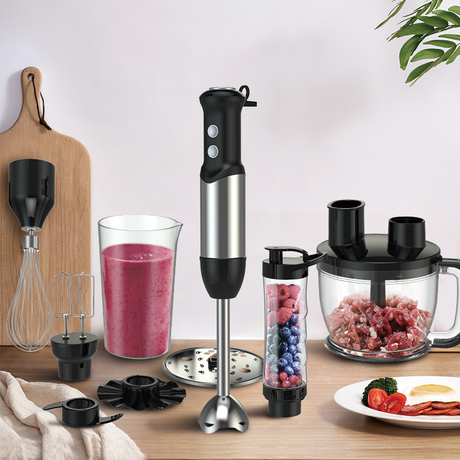
The JM HomeMaster Commercial Bar Blender and Food Crusher brings serious versatility to the table. Rated at 400W with a 1.5L plastic jar (clear glass optional), it features three speeds plus a pulse function, anti-slip rubber feet for stability, and a modular design that accepts different jar types, a filter, and an optional chopper attachment. It holds certifications including CE, CB, CSA, ETL, UL, GS, and RoHS—making it suitable for commercial deployment in multiple regions.
Best for: Food service businesses, bars, commercial kitchens, or any high-frequency food preparation environment.
Feature | Vegetable Chopper | Small Electric Food Chopper | Commercial Food Processor |
|---|---|---|---|
Power | 500W (600W optional) | 300W | 400W |
Capacity | 1.5L | 1.5L | 1.5L (glass jar optional) |
Speeds | 2 speeds + safety switch | 2 speeds + safety switch | 3 speeds + pulse |
Blade | Stainless steel double blade | Stainless steel double blade | Multi-attachment system |
Certifications | CE, CB, RoHS, GS | CE, CB, RoHS, GS | CE, CB, CSA, ETL, UL, GS, RoHS |
Best Use Case | Home food prep | Compact everyday chopping | Commercial / high-volume use |

The decision comes down to three factors: volume, frequency, and environment.
Choose a vegetable chopper if you cook at home regularly and want a powerful, quiet appliance for everyday slicing and dicing.
Choose a small electric food chopper if counter space is limited or your prep tasks are light and quick.
Choose a commercial food processor if you're operating a food business or need an appliance that handles varied, high-frequency tasks with professional-grade reliability.
All three product types from JM HomeMaster are manufactured to ISO9001 standards and carry internationally recognized certifications—so regardless of which you choose, quality is consistent.
Ready to find the right fit? Explore the full range of food choppers and commercial food processors at JM HomeMaster to compare models and request a sample.
A vegetable chopper typically focuses on slicing and dicing produce, while an electric food chopper is a broader category that can handle herbs, cheese, and other ingredients in addition to vegetables. Both use motorized blades, but choppers tend to be more compact.
Yes. Small electric food choppers with stainless steel double blades—such as the JM HomeMaster Electric Mini Food Chopper—are designed to process hard cheese and similar dense ingredients alongside softer produce like herbs and vegetables.
For international commercial use, look for CE, CB, UL, ETL, GS, and RoHS certifications. These confirm that the appliance meets electrical safety, electromagnetic compatibility, and environmental standards across key markets including the US, EU, and Middle East.